
3 Tips on Managing Anxiety



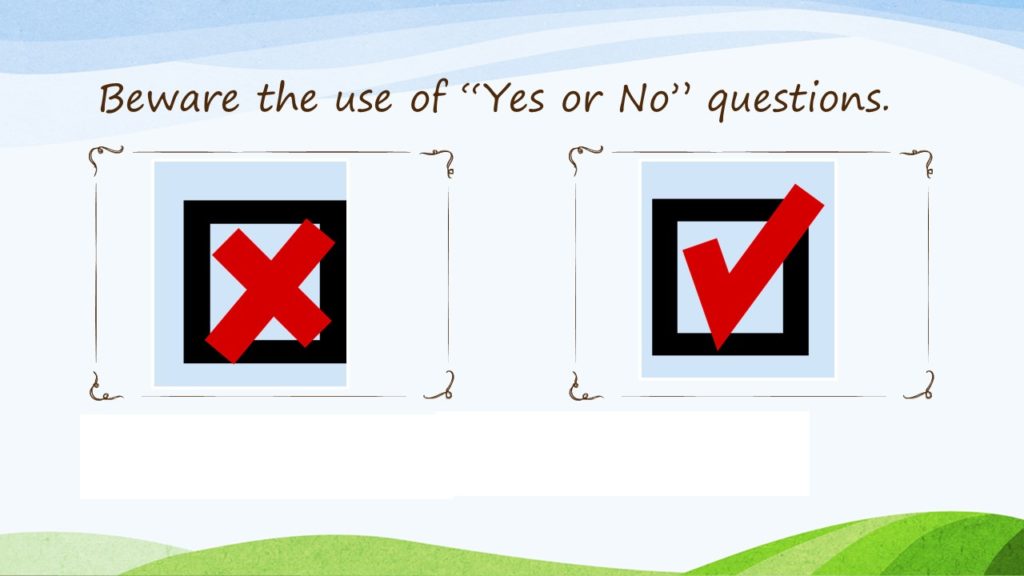
Asking our kids yes-or-no questions is a trap that all parents easily fall into. Sure, there are the easy kids who will get the inference that you want something done and do it. Then there are the kids that when offered these two options, take the one we don’t really want them to.
Here are some examples:
Do you want to get your homework started? No, not really.
Do you want to get your shoes on so we can go? Nope, I’d rather play my video game.
Do you want to help me carry in the groceries? No, thanks.
And now we are stuck in the trap. And then, when we grow frustrated with our child, we may actually be causing confusion. For kids who think along literal lines, they were really offered the choice, so why are you upset with me?
We ask yes-or-no questions mostly out of wanting to ask politely or to be kind. If you really need your child to get something done, you want to use directive language instead.
In five minutes, it will be time to start homework.
Let’s get your shoes on. It’s almost time to go.
I need some help carrying in the groceries. Thanks!
Now that you know, you’ll catch yourself asking yes-or-no questions and realize that you are caught in the trap. And now, you have the tool to extricate yourself. Happy parenting!
You don’t need to have a lot of friends to be happy. A couple of real friends is more important than the number of friends on your social media accounts. It’s good to have at least two friends in your life, in case one friend moves away, or one of your friends is busy or unavailable when you feel the need to be around a friend or want to hang out.
When you do encounter a potential new friend, you can tell if they are going to be a good friend and worth your time by using these friendship test tips.

Does your child exhibit a tendency to be bossy or demanding when playing with friends?
Let’s be honest, we would ALL would like to have our own way ALL the time, but that is just not the reality of living, playing, and working with other people. If your child is adamant about controlling play with peers or demanding things be done a certain way, they will quickly find themselves involved in conflicts, or even with no one to play with at all.
Here is a suggestion for coaching your child on this issue:
When you hear a bossy-sounding statement coming from your child, there is a simple intervention that usually works like magic. Coach your child to exchange the words, “You have to” for “How about we?” Explain that these words give each person the chance to share their ideas and it starts the process of problem-solving toward a mutual solution.
If you find your child continues to be rigid in their thinking and still wants to control the play, take it a step further and explain the probable negative outcome. It can be very powerful asking your child, “Do you want to have friends?” (Most kids will say, “Yes.”) Then say, “Let’s think about what’s not working and see what you might be able to do instead.”
Suggested Coaching Language:
“That sounded a little bossy. Let’s try the magic words and say, ‘How about we (fill in the blank)?’ instead.”
“How about doing it her way first, and your way next.”
“I don’t think that your friend’s ideas are being heard.”

 Social coaching is about observing the obstacles that are getting in the way of a child or teen, and depending on the nature of the child or teen, directly or indirectly pointing out what we see happening, and offering up some food for thought.
Here are some actual instances this past week where food for thought was needed:
A child who was repeating the word suicide and thinking it was funny, or trying to shock everyone. The food for thought there was to think about the possibility that someone in the group had lost someone they loved to suicide, and how funny would it seem to that person. It would not. It would be extremely hurtful.
One of my male teens deliberately inserted himself into a conflict that was occurring between four girls. His food for thought was why he felt the need to do that. Was it just for the thrill of being involved in the conflict or enjoyment of the drama? Was he trying to help? Was it a good idea to get involved?
And, the conflict that he was involved in? One of the girls was playing with a large exercise ball and refusing to kick it around and share it with the other girls. It developed into the girls trying to get the ball from her, arguing with her, and then ultimately excluding her from the group. Her food for thought? Was it worth having her own way to the detriment of having a relationship or friendship with the other girls? When the group started, they were all nicely interacting together. Does getting your own way (and being inflexible about it) overrule the desire or need for positive relationships?
Social coaching involves asking these questions and letting the child or teen do some thinking. Many times, once they have a chance to reflect for a few minutes, you will see the child or teen moving in a more positive direction. Other times, they stand by the negative choice. In those instances, the food for thought is that they have chosen the consequence of their choice, will need to live with the outcomes, and only they have control over whether or not they want to try a different dish at another time in the future.
 My nuclear family crew have historically not been the greatest of communicators, leading to conflicts and misunderstandings. We have agreed to, and have been actively working on this as a family, and seeing some nice improvements. Even as grown adults, we can all still work to improve in the areas that are troublesome. For us, it includes fully listening, clarification on what we hear, and clearness in the messages we send and speak.
One important rule that we follow, and that I teach to parents and educators, is to make sure that we are addressing the action or the problem to be solved, and not attacking the person. Examples sound like:
When we address the action and not attack the person, we have a much greater chance of better communication, getting our needs met, and the lessening of conflicts. Try the “I” statement rather than the “You” accusation language and see what happens in your interactions.

Conversation skills are something that many parents ask us to work on when we are social coaching kids. The ability to initiate and sustain a conversation can prove a huge task, taking a large degree of effort, especially for kids with a known social communication difficulty. There are ways to break down a conversation into parts.
Conversations are made up of just two elements, comments and questions. So, kids need to learn to make a comment and ask a question. If you decide to practice this at home, two comments to each question is a good start, and then switch roles.
Some kids get stuck on asking questions. We can simplify this component by teaching kids that most questions in a conversation are WH questions. Who, What, When, Why, Where, Whose, Which, and How (which contains a W and an H).
A conversation practice session could go something like this:
Q: Who is your teacher next year? A: Mrs. Smith.
C: I hear she’s really nice. C: She doesn’t give a lot of homework.
Q: Where is your homeroom? A: On the second floor.
C: That must mean you are in 5th grade.
Q: When does school start in your town? A: September 8th.
C: I start on the 16th. C: It will be two days in school and three days at home.
Q: How do you get to school? A: I ride the bus.
C: My mom drives me.
Q: What is your favorite subject? A: Math
C: You must be good at math. C: I like science the best.
If your child struggles with conversation skills, have them memorize the WH questions and think of them as a tool in their communication toolbox. If they are ever in doubt during a conversation, they can enter with a WH question on the topic being discussed.

Friendships don’t just happen. Well, maybe there is that occasional friendship at first sight. And even then, in order for that friendship to grow and continue, there has to be an effort. When kids are little, parents make the effort for them by scheduling playdates or befriending other moms. As kids grow, we should be teaching kids how to take over the reins of their friendships.
What should kids know about attaining, maintaining, and sustaining friendships?
If you want something badly enough, such as having friends, you can make it happen. It doesn’t happen by sitting home and moping about not having friends. It doesn’t happen by not talking to anyone in your class. It doesn’t happen by magic. It takes work.
 By Donna Shea
When I was 5-years-old, I got caught shoplifting. We were at a local vegetable and fruit stand and I saw one of those big carpenter pencils. I wanted it to draw with, and I took it. I knew what I was doing was wrong, because I hid it. Back in the car, I took it out to admire it and my mother saw me with it.
She immediately knew what I had done, and turned the car around. She walked me back into the store and, through my tears, had me confess, apologize, and promise to never to it again. And guess what? I haven’t. A life of crime was not for me.
Kids can be naughty. And they can be naughty on purpose. My mom made no excuses for my behavior and I felt ashamed that day. Not shamed in the way we use the term in the more current culture, but embarrassed by the knowledge that my own choices had caused that consequence that day.
There are two occasions that I remember working with kids that this concept of a healthy amount of shame came up, with different outcomes. In one instance, one of the kids had been targeting another during group with mean behavior. When the conflict escalated and the second child tried to defend themself, that first child tried to blame the second one. Since I had witnessed the entire situation, I wasn’t buying it and told the first child that I had seen it, I wanted it to stop, and that she had asked for and deserved the response she had received. I then left her to think about it, and you could see the struggle with a small dose of understanding that she had done wrong. After a time, she rejoined the session and we continued from where we had left off. The mean moments ended.
On another occasion, a child deliberately destroyed something in my office that was important to the people who were working on it. When I firmly called them to the carpet about that choice, there were tears. I explained that the feeling they were having was something called shame. It was okay to feel it, and should be felt when we do something that we know is wrong. Unfortunately, the story that the parent got about the incident was that it was an accident, and the parent took the child’s untruth as truth. What does that teach? That you can get away with things and people will make excuses for your choices.
I’m not talking at all about shaming children who struggle with symptoms of ADHD or have other challenges. I’m talking about the deliberate naughtiness that all children are capable of. Shame is an emotion that all humans feel. Negative emotions exist for a reason. A healthy dose of shame is part of our moral compass. When we do something we know is wrong, shame helps us find our way back to right.
 Most adults would fill in that blank with “so.” “Because I said so” is a phrase that kids hear pretty frequently. In my experience, when I am in the “because I said so” mode with kids, they either ignore my request in its demand form or increase the times they push up against that “so” and behavior increases rather than decreases.
Children are a pretty savvy group of people these days. If you think about it, it’s a good thing not to be a blind follower of what someone tells you to do. But how are we, as parents or adults who work with kids, get them to follow the rules or do as we ask?
It occurred to me one day running a group that maybe kids would do better if I explained the reasoning behind the request or the demand I was making. As an example, my group room has a slippery laminate floor, so we have a rule about not running and sliding in stockinged feet. Over and over, my staff and I found ourselves being on kids for doing precisely what we asked them not to do. “Because I said so” wasn’t working. I sat them all down, and I said that I wanted to try something different. I explained that I realized that many times, grownups said, “because I said so” about something and never told kids why. I noted that grown-ups don’t make up rules to be mean or to stop kids from having fun. So I said from now on, I would tell them “why” I had a specific rule or made a particular request.
In the example above, I told the kids that the rule about not sliding around in their stockinged feet was first and foremost to keep them safe from falling and hurting themselves on a hard and unforgiving surface. The second was to keep the walls of our group room from getting damaged. It happened three times when sliding feet turned into knees through the wall. I keep one of those holes unrepaired and covered by a bookshelf as an example of the “why” I have that rule, and I show it to kids who need to see it to understand.
I promised the kids that from now on, I would work hard to say “because I said and why” instead of “because I said so” and that they were allowed to ask me “why” if I should forget. One of the boys breathed a sigh of relief and said, “Miss Donna, why can’t all adults do that?” Well, maybe this idea might catch on, and this guy’s wish will come true. It only takes a minute to give a child a “why.”
