



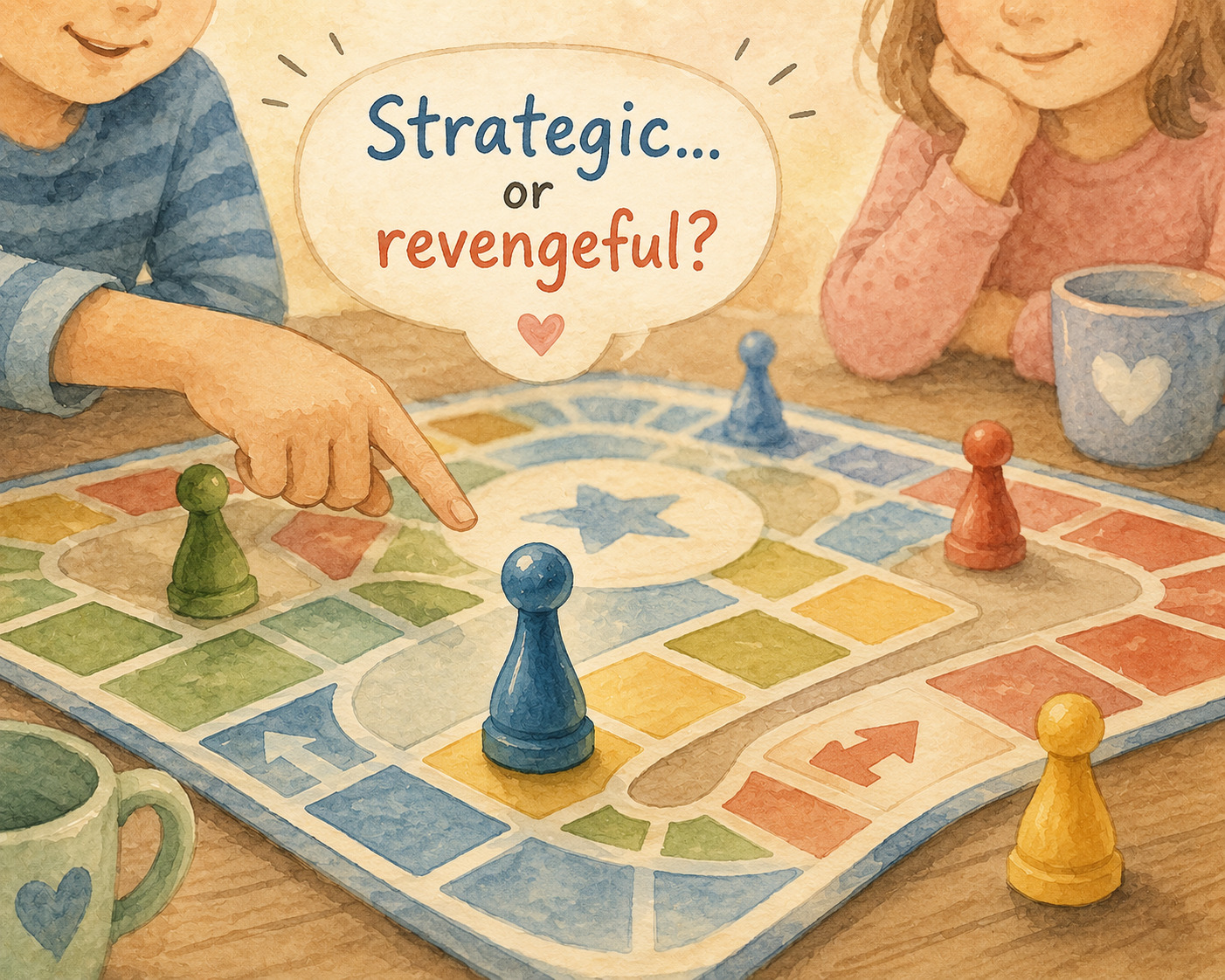
A funny thing happens during board games with kids when the line between strategically vs. revengefully starts to blur. Everyone starts out smiling… until somebody gets sent home in Sorry.
Suddenly the room changes.
“That’s SO MEAN!”
“You only did that because I got YOU!”
“You’re targeting me!”
And honestly? Sometimes they’re right.
The Difference Between Strategic Play and Revenge Play
One of the social concepts we work on here is the difference between playing strategically and playing revengefully.
Because there’s a big difference between:
- “I made this move because it helps my game, AND
- “I made this move because I wanted to upset you.”
Kids often assume any frustrating move is automatically personal. But sometimes a move really is just the most strategic option on the board.
A Simple Coaching Question That Changes the Tone
Instead of immediately stepping in as the referee, I’ll often pause the game and ask the group:
“What’s the most strategic move here?”
And something interesting happens.
The emotional temperature in the room usually drops.
The players start thinking instead of reacting.
They begin looking at the whole board.
They explain their reasoning.
And very often, the group agrees on the same move.
That shift matters.
Strategically vs. Revengefully: Teaching Kids Good Sportsmanship
Board games are supposed to be social and fun — not a duel to the death fought with tiny plastic pawns. 😊
Just because a move is allowed doesn’t always mean it’s socially wise. Kids can technically follow the rules while still creating tension, embarrassment, or hurt feelings around the table.
That’s where the real coaching comes in.
We talk about:
- how to stay competitive without making the game feel personal,
- how to think about the experience of the other players,
- and how to win — or lose — in a way that still makes people want to play another round.
Why Board Games Are Such Powerful Social Learning Tools
Honestly, board games are one of the safest places to practice these skills.
They teach:
- flexibility,
- emotional regulation,
- perspective-taking,
- and sportsmanship.
They also help kids learn how to handle disappointment without turning the whole thing upside down.
Sometimes the real winner of the game is simply the player everyone still wants to play with afterward.
Looking for More Support?
If you’re seeing this pattern and want support, this is exactly the kind of real-time coaching we focus on in our social groups at the Peter Pan Center in Boxborough MA.
I also create printable tools, books, and workbooks designed to help kids practice these skills in everyday interactions.
👉 Download the “Strategically vs. Revengefully” printable here.

Leave a Reply